Laanaana
Les Choses humainesRa’anana is the Israeli city where Adam Wizman and his family moved after the 2012 attack on the Jewish school attended by his daughters. Their six-month stay became a failed refuge: Adam could not make a home there without feeling forced to alter himself, and the return to France left the family’s migration, religious life, and loyalties unsettled.
Setting and the Search for Safety
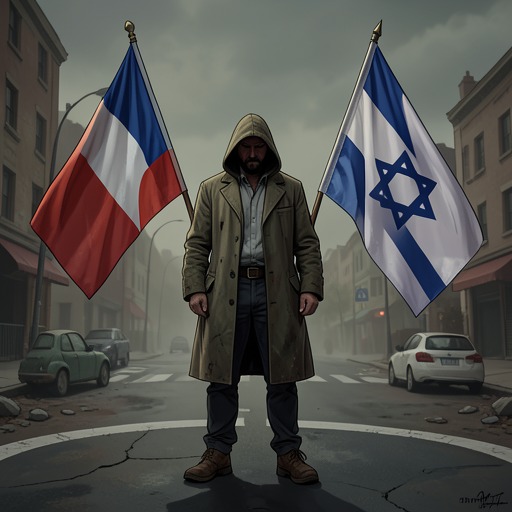
After the attack, Adam and his wife withdrew their daughters from school and, like many relatives and friends, decided to leave France. Their conversations returned to the fear that European Jews could no longer ignore antisemitism that killed, and that they or their children might eventually have to leave to escape it. In haste, the family settled in Israel, choosing Ra’anana, a city of about 80,000 northeast of Tel Aviv with numerous immigrant communities, including French Jews. The account places their personal flight within a wider movement: nearly 20,000 French Jews emigrated to Israel over three years.
A Failed Experience of Belonging
The family rented an apartment in Ra’anana for six months, but the experience was disastrous. Adam felt a profound attachment to the land, yet believed that integrating there would require a deformation of his character, a price he was unwilling to pay. Everyday life felt aggressively charged to him. Accustomed to the solitude of living as a minority, he was uncomfortable among other Jews and found that the familiarity and fraternity he often felt when meeting Jews abroad did not arise in Israel. The city thus marks a sharp contrast between attachment to a place and the difficulty of inhabiting it.
Adam’s estrangement was political as well as social. He was troubled by what he saw as the lack of political consciousness among those who had emigrated for the same reasons he had. The Israeli-Palestinian conflict, in his view, had become an abstract reality that people denied or accepted as an inevitable fate. In the name of security and peace of mind, they appeared to him to tolerate a moral defeat at odds with the humanist Judaism he identified with. Ra’anana did not resolve the fear that had prompted the move; it exposed a different conflict between personal safety and political conscience.
Return and Family Consequences
Adam and his family eventually returned to France, dispirited by the failure and suffering of the experiment. He soon took a French-teaching job at a Jewish school, and the family lived in a largely closed communal world. During this period his wife became more observant, a change that would deepen the distance between them. The return was therefore not a restoration of the family’s earlier life: the move had changed the conditions under which they lived and sharpened the tensions around religious identity and marriage.
The consequences extended into the next generation. Years later, Adam’s former wife moved with their daughters to Brooklyn, settling in the ultra-Orthodox Jewish neighborhood of Crown Heights. The older daughter, Mila, could not tolerate the religious milieu and its control over how she dressed, walked, and thought; she arrived at Adam and Claire’s home with a suitcase. At the trial, a psychologist connected Mila’s later distress to the instability that followed the Toulouse attack, including the family’s hurried departure for Israel and the failed move. Ra’anana is thus a brief stop in a longer displacement, one whose effects persisted well after the family left the city.